

Why Choose Us
Our certifications
Our company has passed the IATF16949 quality management system certification.
Advanced production equipment
Our factory is located in Zhanjiang, a sub-center city of Guangdong Province. As a national high-tech enterprise, we have advanced technique,production equipment and detection means.
Rich experience
With over 30 years manufacturing experience, excellent customization ability, reliable quality, competitive prices and fast delivery, we can assure you that choosing us as your supplier is the right thing to do. Welcome to send drawings or samples for customized production.
In-sales Service
Our order management system tracks every order from placement to shipment, ensuring accuracy & efficiency. We update customers regularly and keep them informed of the order fulfillment status. Meanwhile, We strictly implement our product quality management system to ensure the quality and performance of our products.
What is Muffler
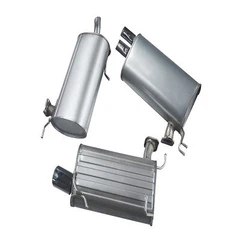
A muffler's primary function is to reduce the noise produced by the engine's exhaust gases. It also helps in directing these gases safely out of the vehicle. However, the placement of the muffler can influence several other factors, including backpressure, exhaust flow, and temperature management.The car muffler is an integral part of the exhaust system, located close to the exhaust pipes at the vehicle's rear. As the name suggests, it's a component that aids in muffling and reducing the sounds and vibrations produced by the car engines.The noise muffling action results from the bulkhead and a winding pipe, two important features of a typical car muffler. Consequently, some refer to the muffler as a silencer, as it helps to reduce noise-a byproduct of the car engine combustion process.Car mufflers are usually manufactured using sturdy materials like aluminum and steel, creating a bridge between the car engine and the exhaust system.
-
![Rear Muffler For Mitsubishi Outlander 3.0L]() Rear Muffler For Mitsubishi Outlander 3.0L
Rear Muffler For Mitsubishi Outlander 3.0LRear Muffler for 2007-2013 Mitsubishi Outlander, 3.0L,H-LINE(4WD/5P/PROCONVE L5),S6FA/T. The product can be used in the automotive aftermarket in Brazil, South Korea, Mexico and so on. Not only
-
![REAR MUFFLER For TOYOTA HIGHLANDER GSU4#]() REAR MUFFLER For TOYOTA HIGHLANDER GSU4#
REAR MUFFLER For TOYOTA HIGHLANDER GSU4#EXHAUST ASSEMBLY for 2007-2013 HIGHLANDER/KLUGER,one of the best-selling SUVs in the global market. This part is the terminal component of a vehicle's exhaust system, responsible for discharging
-
![Muffler Assembly For COROLLA ZRE172]() Muffler Assembly For COROLLA ZRE172
Muffler Assembly For COROLLA ZRE172Rear Muffler for COROLLA ZRE172( 2013-2019), the classic representative of the compact car market, with reliability, comfort, and economy as its core selling points.
-
![REAR MUFFLER For Mitsubishi ASX]() REAR MUFFLER For Mitsubishi ASX
REAR MUFFLER For Mitsubishi ASXREAR MUFFLER for Mitsubishi ASX, exported to Brazil.
-
![REAR MUFFLER For CHEVROLET Aveo]() REAR MUFFLER For CHEVROLET Aveo
REAR MUFFLER For CHEVROLET AveoREAR MUFFLER for CHEVROLET Aveo Aveo Hatchback(2004-2008), applicable to most countries.
-
![CENTER MUFFLER For CHEVROLET Aveo]() CENTER MUFFLER For CHEVROLET Aveo
CENTER MUFFLER For CHEVROLET AveoCENTER MUFFLER for CHEVROLET Aveo(2012-2018), applicable in AFRICA/ MALAYSIA/PHILIPPINES/SINGAPORE/UKRAINE/RUSSIA/ INDONESIA/ SOUTH AFRICA/ MIDDLE EAST/ISRAEL.
-
![REAR MUFFLER For Toyota RAV4 ACA3#]() REAR MUFFLER For Toyota RAV4 ACA3#
REAR MUFFLER For Toyota RAV4 ACA3#Tail pipe for Toyota RAV4 ACA3#( 2005-2012), applicable to general countries.
-
![REAR MUFFLER For Toyota RAV4 SXA1#]() REAR MUFFLER For Toyota RAV4 SXA1#
REAR MUFFLER For Toyota RAV4 SXA1#REAR MUFFLER for Toyota RAV4 SXA1#( 1994-2000), applicable to general countries.
-
![REAR MUFFLER For TOYOTA LAND CRUISER 100]() REAR MUFFLER For TOYOTA LAND CRUISER 100
REAR MUFFLER For TOYOTA LAND CRUISER 100REAR MUFFLER for TOYOTA LAND CRUISER 100 (1998-2007), applicable to general countries.
-
![CENTER MUFFLER For LEXUS LX470]() CENTER MUFFLER For LEXUS LX470
CENTER MUFFLER For LEXUS LX470CENTER MUFFLER for LEXUS LX470/ LAND CRUISER 100 UZJ100, applicable to General Countries.
-
![REAR MUFFLER For Toyota RAV4 XA20]() REAR MUFFLER For Toyota RAV4 XA20
REAR MUFFLER For Toyota RAV4 XA20REAR MUFFLER for Toyota RAV4 XA20 NCP61, commonly used in general countries worldwide.
-
![Center Muffler For Toyota FJ CRUISER]() Center Muffler For Toyota FJ CRUISER
Center Muffler For Toyota FJ CRUISERCenter Muffler for Toyota FJ CRUISER which has a high retention rate in the global second-hand market due to its classic designs and powerful off-road performance.


