

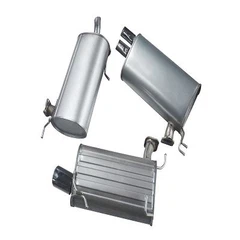
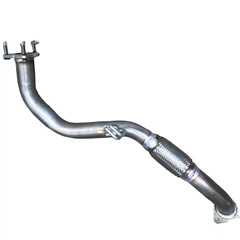
What is the cross - sectional area of a center muffler for 9th gen Honda Accord?
Oct 14, 2025
Leave a message
As a dedicated supplier of center mufflers for the 9th generation Honda Accord, I often encounter inquiries regarding the cross - sectional area of these crucial automotive components. In this blog post, I aim to provide a comprehensive exploration of the cross - sectional area of the center muffler for the 9th gen Honda Accord, delving into its significance, factors affecting it, and how it relates to the overall performance of the vehicle.
Understanding the Center Muffler
Before we dive into the cross - sectional area, it's essential to understand the role of the center muffler in a vehicle's exhaust system. The center muffler is one of the key components in the exhaust line, working in tandem with other mufflers and pipes to reduce the noise generated by the engine's exhaust gases. It also helps in optimizing the backpressure within the exhaust system, which can have a significant impact on engine performance, fuel efficiency, and emissions.
The 9th generation Honda Accord, produced from 2013 to 2017, came with different engine options, including 2.4 - liter and 3.5 - liter engines. Each engine configuration may have specific requirements for the center muffler, and the cross - sectional area plays a vital role in meeting these requirements.


Significance of the Cross - Sectional Area
The cross - sectional area of the center muffler is a critical parameter that affects several aspects of the exhaust system's performance. Here are some of the key reasons why it matters:
Noise Reduction
The cross - sectional area influences the way sound waves travel through the muffler. A larger cross - sectional area allows for more space for the sound waves to expand and dissipate, resulting in better noise reduction. By carefully designing the cross - sectional area, we can tune the muffler to reduce the specific frequencies of noise produced by the engine, providing a quieter driving experience for the occupants of the 9th gen Honda Accord.
Backpressure Management
Backpressure is the resistance that the exhaust gases encounter as they flow through the exhaust system. While some backpressure is necessary for proper engine operation, excessive backpressure can reduce engine power and efficiency. The cross - sectional area of the center muffler can be adjusted to control the backpressure. A larger cross - sectional area generally reduces backpressure, allowing the exhaust gases to flow more freely. However, if the area is too large, it may lead to a loss of low - end torque. On the other hand, a smaller cross - sectional area can increase backpressure, which may be beneficial for certain engine configurations, especially those that require more torque at low RPMs.
Exhaust Gas Flow
The cross - sectional area also affects the velocity of the exhaust gases. A smaller cross - sectional area will increase the gas velocity, which can help in scavenging the exhaust gases from the cylinders more effectively. This can improve engine breathing and performance, especially at high RPMs. However, if the velocity is too high, it can also cause turbulence and increase noise levels. A well - designed cross - sectional area strikes a balance between gas velocity and noise reduction.
Factors Affecting the Cross - Sectional Area
Several factors influence the optimal cross - sectional area of the center muffler for the 9th gen Honda Accord. These include:
Engine Displacement
As mentioned earlier, the 9th gen Honda Accord had different engine displacements. Larger engines typically produce more exhaust gases, and therefore, may require a larger cross - sectional area in the center muffler to accommodate the increased gas flow. For example, the 3.5 - liter engine will have a higher exhaust volume compared to the 2.4 - liter engine, and the center muffler for the 3.5 - liter engine may need to have a larger cross - sectional area to ensure efficient exhaust gas flow and proper backpressure management.
Exhaust System Design
The overall design of the exhaust system, including the layout of the pipes, the presence of other mufflers, and the diameter of the exhaust pipes, also affects the cross - sectional area of the center muffler. A well - integrated exhaust system design takes into account the flow characteristics of the entire system and ensures that the center muffler's cross - sectional area is compatible with the rest of the components. For instance, if the exhaust pipes leading to and from the center muffler have a certain diameter, the cross - sectional area of the muffler should be designed to match the flow requirements of these pipes to minimize turbulence and pressure drops.
Performance Requirements
The performance requirements of the vehicle also play a role in determining the cross - sectional area. If the vehicle is intended for high - performance driving, such as racing or spirited driving, the center muffler may be designed with a larger cross - sectional area to reduce backpressure and allow for more power output. On the other hand, if the focus is on fuel efficiency and quiet operation, a smaller cross - sectional area may be used to optimize backpressure and noise reduction.
Measuring the Cross - Sectional Area
Measuring the cross - sectional area of the center muffler can be a complex task, as the shape of the muffler is often irregular. However, there are several methods that can be used:
Direct Measurement
For a simple cylindrical or rectangular - shaped muffler, the cross - sectional area can be measured directly using basic geometric formulas. For a circular cross - section, the area (A) can be calculated using the formula A = πr², where r is the radius of the circle. For a rectangular cross - section, the area is calculated as A = length × width.
Computational Fluid Dynamics (CFD)
CFD is a powerful tool that can be used to simulate the flow of exhaust gases through the muffler and calculate the cross - sectional area at different points. By creating a 3D model of the muffler and using CFD software, we can analyze the flow patterns, pressure distribution, and other parameters. This allows us to optimize the cross - sectional area based on the actual flow conditions inside the muffler.
Our Center Mufflers for the 9th Gen Honda Accord
As a supplier of center mufflers for the 9th gen Honda Accord, we take great care in designing and manufacturing our products to meet the highest standards. Our center mufflers are engineered with the optimal cross - sectional area to ensure excellent noise reduction, proper backpressure management, and efficient exhaust gas flow.
We use high - quality materials and advanced manufacturing techniques to produce mufflers that are durable and reliable. Our team of engineers and technicians conducts extensive testing to ensure that each muffler meets the performance requirements of the 9th gen Honda Accord.
In addition to our center mufflers for the 9th gen Honda Accord, we also offer a wide range of other mufflers for different makes and models. For example, you can check out our CENTER MUFFLER For CHEVROLET Aveo, Rear Muffler for Isuzu Re - Max RM493, and Center Muffler for 2003 - 2015 Mitsubishi Lancer.
Contact Us for Procurement
If you are interested in purchasing our center mufflers for the 9th gen Honda Accord or any of our other products, we encourage you to get in touch with us. We are always ready to discuss your specific requirements and provide you with the best solutions. Whether you are an automotive repair shop, a distributor, or an individual looking for a replacement muffler, we can offer you high - quality products at competitive prices.
References
- Heywood, J. B. (1988). Internal Combustion Engine Fundamentals. McGraw - Hill.
- Taylor, C. F. (1985). The Internal Combustion Engine in Theory and Practice. MIT Press.
- "Exhaust System Design and Performance", SAE International.
Send Inquiry