

What is the difference between a direct - acting and a pilot - operated manifold outlet valve?
Aug 26, 2025
Leave a message
Hey there! As a supplier of Manifold Outlets, I often get asked about the difference between direct - acting and pilot - operated manifold outlet valves. So, I thought I'd take a moment to break it down for you in a way that's easy to understand.
First off, let's talk about what a manifold outlet valve is. In simple terms, it's a crucial part of an exhaust system. If you're interested in learning more about manifold outlets, you can check out our Manifold Outlet page. It's like the gateway that controls the flow of exhaust gases from the engine to the rest of the exhaust system.
Now, onto the main topic: the difference between direct - acting and pilot - operated manifold outlet valves.
Direct - Acting Manifold Outlet Valves
Direct - acting valves are pretty straightforward. They work based on a direct mechanical or electrical connection to control the flow of fluid or gas. In the case of a manifold outlet valve, when you want to open or close the valve, there's a direct action happening.
Let's say you've got an electric direct - acting valve. When you send an electrical signal, it directly moves a plunger or a disc inside the valve to either allow the exhaust gases to flow or stop them. It's like flipping a switch. There are no intermediary steps involved.
One of the biggest advantages of direct - acting valves is their simplicity. They're easy to install and maintain. You don't need a whole bunch of extra components to make them work. Also, they tend to have a fast response time. Since there's no delay caused by additional control mechanisms, they can open or close almost instantly when you send the signal.
However, direct - acting valves do have their limitations. They're not very suitable for high - pressure or high - flow applications. The force required to move the internal components against a high - pressure flow can be quite large. So, if you're dealing with a system that has a lot of pressure or a high volume of exhaust gases, a direct - acting valve might struggle to perform effectively.
Pilot - Operated Manifold Outlet Valves
Pilot - operated valves, on the other hand, are a bit more complex but offer some significant benefits. Instead of directly controlling the main valve, a pilot - operated valve uses a small, secondary valve (the pilot valve) to control the pressure and flow in a chamber that then moves the main valve.
Here's how it works. When you send a signal, the pilot valve opens or closes, which changes the pressure in a control chamber. This pressure change then causes the main valve to open or close. It's like a two - step process.


The main advantage of pilot - operated valves is their ability to handle high - pressure and high - flow applications. Since the pilot valve only needs to control a small amount of pressure to move the main valve, it can operate effectively even when there's a lot of pressure in the system. They're also more energy - efficient in some cases. Because the pilot valve can be designed to use less power to control the main valve, you can save on energy costs over time.
But, like everything, pilot - operated valves have their downsides. They're more complex to install and maintain. You need to make sure the pilot valve is working correctly, and there are more components that can potentially fail. Also, they tend to have a slower response time compared to direct - acting valves because of the two - step process involved.
Which One Should You Choose?
So, how do you decide whether to go for a direct - acting or a pilot - operated manifold outlet valve? Well, it really depends on your specific needs.
If you have a small - scale system with low pressure and low flow, a direct - acting valve might be the way to go. It's simple, reliable, and cost - effective. You won't have to worry about the extra complexity of a pilot - operated valve.
On the other hand, if you're dealing with a large - scale industrial system with high pressure and high flow, a pilot - operated valve is probably your best bet. It can handle the demands of the system more effectively, even though it might be a bit more expensive and require more maintenance.
Other Related Parts in the Exhaust System
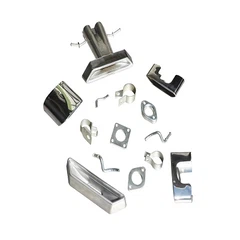
While we're on the topic of exhaust systems, it's worth mentioning a few other important parts. For example, the Custom Exhaust Metal Flange is used to connect different sections of the exhaust pipe. It provides a tight seal to prevent exhaust gases from leaking.
Another part is the Muffler Bracket. As the name suggests, it's used to hold the muffler in place. A good muffler bracket ensures that the muffler stays secure and functions properly.
Contact Us for Your Manifold Outlet Needs
If you're still not sure which type of manifold outlet valve is right for you, or if you have any other questions about our products, don't hesitate to reach out. We've got a team of experts who can help you make the right choice based on your specific requirements. Whether you need a direct - acting or a pilot - operated valve, we've got you covered.
Let's work together to find the perfect solution for your exhaust system. We're committed to providing high - quality products and excellent customer service. So, if you're in the market for a manifold outlet valve or any other exhaust system parts, get in touch with us today.
References
- "Valve Handbook" by Valve Manufacturers Association
- Various industry whitepapers on exhaust system components
Send Inquiry