

What is the impact of a center muffler on the exhaust gas velocity on a Toyota Prado 4.0L?
May 15, 2025
Leave a message
As a supplier of Center Muffler for Toyota Prado 4.0L, I've been deeply involved in understanding the intricacies of exhaust systems and their components. One question that often arises is about the impact of a center muffler on the exhaust gas velocity in a Toyota Prado 4.0L. In this blog, I'll delve into this topic, exploring the science behind it and how it affects the overall performance of the vehicle.
The Basics of Exhaust Gas Flow and Mufflers
Before we discuss the specific impact of a center muffler on exhaust gas velocity, it's important to understand the basic principles of exhaust gas flow in an internal combustion engine. When the engine burns fuel, it produces exhaust gases that need to be expelled from the cylinders. These gases flow through the exhaust manifold, down the exhaust pipes, and eventually out of the tailpipe.
The exhaust system plays a crucial role in this process. It not only channels the exhaust gases out of the engine but also helps to reduce noise and control emissions. Mufflers are an essential part of the exhaust system, designed to dampen the sound waves produced by the engine. There are different types of mufflers, including the center muffler, which is typically located in the middle of the exhaust system.
How a Center Muffler Works
A center muffler works by using a series of chambers and baffles to reflect and absorb sound waves. As the exhaust gases enter the muffler, they are forced to flow through these chambers, which causes the sound waves to bounce around and lose energy. This results in a reduction in noise levels.
However, the design of the center muffler also has an impact on the exhaust gas velocity. The chambers and baffles inside the muffler create resistance to the flow of exhaust gases. This resistance can either increase or decrease the exhaust gas velocity, depending on the design of the muffler.

Impact on Exhaust Gas Velocity
The impact of a center muffler on exhaust gas velocity can be both positive and negative, depending on the specific design and the requirements of the vehicle.
Positive Impact
- Backpressure Control: In some cases, a well - designed center muffler can help to maintain an optimal level of backpressure in the exhaust system. Backpressure is the resistance that the exhaust gases encounter as they flow through the exhaust system. A certain amount of backpressure is necessary for the engine to operate efficiently. A center muffler can help to control the backpressure by providing a specific amount of resistance to the exhaust gas flow. This can improve the scavenging effect, which is the process of removing the exhaust gases from the cylinders. When the scavenging effect is improved, the engine can breathe better, resulting in increased power and torque.
- Smoothing the Flow: The center muffler can also help to smooth out the flow of exhaust gases. The chambers and baffles inside the muffler can break up the high - velocity pulses of exhaust gases, creating a more continuous and stable flow. This can reduce turbulence in the exhaust system, which in turn can improve the overall efficiency of the engine.
Negative Impact
- Restriction: On the other hand, if the center muffler is too restrictive, it can significantly reduce the exhaust gas velocity. A muffler with a small diameter or too many chambers and baffles can create a bottleneck in the exhaust system. This can cause the exhaust gases to build up in the engine, increasing the backpressure to an undesirable level. When the backpressure is too high, it can reduce the engine's power output and fuel efficiency. The engine has to work harder to push the exhaust gases out, which means more energy is wasted.
Considerations for Toyota Prado 4.0L
The Toyota Prado 4.0L is a powerful SUV with a V6 engine. The engine is designed to produce a significant amount of power and torque, and the exhaust system needs to be able to handle the large volume of exhaust gases.
When choosing a center muffler for a Toyota Prado 4.0L, it's important to consider the balance between noise reduction and exhaust gas flow. A muffler that is too quiet may be too restrictive, while a muffler that allows for unrestricted flow may be too loud.
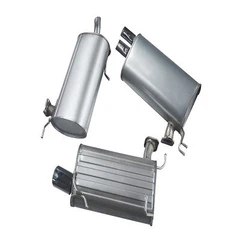
At our company, we offer a Center Muffler for Toyota Prado 4.0L that is specifically designed to meet the needs of this vehicle. Our center muffler is engineered to provide optimal backpressure control and smooth exhaust gas flow, while also reducing noise to an acceptable level.
Other Muffler Options
In addition to the center muffler for the Toyota Prado 4.0L, we also offer a range of other mufflers for different vehicles. For example, we have a Center Muffler for 2013 Nissan Tiida and a Rear Muffler for 2013 Mitsubishi Outlander 2.4L. These mufflers are also designed to provide a balance between noise reduction and exhaust gas flow, ensuring optimal performance for each vehicle.
Conclusion
In conclusion, the center muffler has a significant impact on the exhaust gas velocity in a Toyota Prado 4.0L. A well - designed center muffler can improve the engine's performance by controlling backpressure and smoothing the exhaust gas flow. However, a poorly designed muffler can restrict the flow of exhaust gases, reducing power and fuel efficiency.

If you're looking for a high - quality center muffler for your Toyota Prado 4.0L or other vehicles, we're here to help. Our team of experts can provide you with the best advice and products to meet your needs. Whether you're looking to improve the performance of your vehicle or simply reduce the noise, we have the solution for you. Contact us to start a procurement discussion and find the perfect muffler for your vehicle.
References
- Heywood, J. B. (1988). Internal Combustion Engine Fundamentals. McGraw - Hill.
- Taylor, C. F. (1985). The Internal Combustion Engine in Theory and Practice. MIT Press.
Send Inquiry