

What is the purpose of a muffler?
Sep 05, 2025
Leave a message
A muffler, also known as a silencer in some regions, is an essential component of a vehicle's exhaust system. As a leading muffler supplier, I've witnessed firsthand the crucial role mufflers play in modern automotive engineering. In this blog post, I'll delve into the purpose of a muffler, exploring its functions, benefits, and the different types available on the market.
The Primary Purpose: Noise Reduction
One of the most well - known functions of a muffler is to reduce the noise produced by the engine's exhaust gases. When an engine combusts fuel, it creates a series of rapid explosions. These explosions generate high - pressure sound waves that travel through the exhaust system. Without a muffler, the noise from these sound waves would be extremely loud, not only causing a nuisance to the vehicle's occupants but also to the surrounding environment.
The muffler achieves noise reduction through a series of chambers and baffles. As the exhaust gases enter the muffler, they are forced to pass through these chambers. The design of the chambers and baffles causes the sound waves to bounce around and interfere with each other. This interference cancels out some of the sound energy, resulting in a quieter exhaust note.
For example, in a typical straight - through muffler, the exhaust gases flow through a perforated tube surrounded by sound - absorbing material. The perforations allow the sound waves to enter the sound - absorbing material, where they are dissipated as heat. In a chambered muffler, the exhaust gases are redirected through a series of chambers, and the sound waves are reflected and absorbed, reducing the overall noise level.
Backpressure Regulation
Another important purpose of a muffler is to regulate backpressure in the exhaust system. Backpressure is the resistance that the exhaust gases encounter as they flow through the exhaust system. While it might seem counterintuitive, a certain amount of backpressure is necessary for the proper functioning of an engine.
A well - designed muffler helps maintain an optimal level of backpressure. If the backpressure is too low, the engine may experience a loss of torque, especially at low RPMs. This is because the scavenging effect, which helps draw in fresh air - fuel mixture into the cylinders, is disrupted. On the other hand, if the backpressure is too high, it can restrict the flow of exhaust gases, causing the engine to work harder and reducing its efficiency.
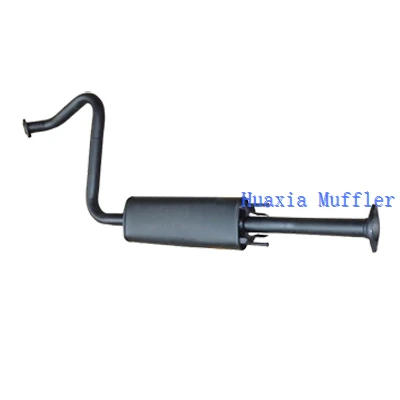

Our company offers a wide range of mufflers that are carefully engineered to provide the right balance of backpressure for different types of engines. For instance, Rear Muffler for Mitsubishi Delica 6473 is designed to work in harmony with the engine of the Mitsubishi Delica 6473, ensuring optimal performance and efficiency.
Emission Control
Mufflers can also play a role in emission control. Some modern mufflers are equipped with catalytic converters or other emission - control devices. Catalytic converters are designed to reduce harmful emissions such as carbon monoxide, hydrocarbons, and nitrogen oxides by converting them into less harmful substances like carbon dioxide, water, and nitrogen.
The muffler provides a housing for the catalytic converter and helps maintain the proper temperature for its operation. The exhaust gases flow through the catalytic converter, where the chemical reactions take place. The muffler also helps to prevent the catalytic converter from being damaged by external factors such as road debris.
For example, the REAR MUFFLER For Mitsubishi ASX is designed to work in conjunction with the vehicle's emission - control system, ensuring that the vehicle meets the required emission standards.
Types of Mufflers
There are several types of mufflers available on the market, each with its own unique design and performance characteristics.
- Straight - Through Mufflers: These mufflers offer a high - flow design, which means they allow the exhaust gases to flow through with minimal restriction. This results in increased horsepower and a more aggressive exhaust note. Straight - through mufflers are popular among performance enthusiasts.
- Chambered Mufflers: Chambered mufflers use a series of chambers and baffles to reduce noise. They provide a good balance between noise reduction and backpressure regulation. Chambered mufflers are commonly used in stock vehicles.
- Turbo Mufflers: Turbo mufflers are designed to work with turbocharged engines. They are typically more efficient at reducing noise and regulating backpressure in high - performance turbocharged applications.
The Importance of Quality Mufflers
As a muffler supplier, I understand the importance of providing high - quality mufflers. A poorly designed or low - quality muffler can lead to a variety of problems. It may not effectively reduce noise, resulting in a noisy vehicle. It may also cause improper backpressure regulation, leading to reduced engine performance and efficiency.
In addition, a low - quality muffler may not be durable and may require frequent replacement. This can be costly for the vehicle owner in the long run. Our company uses high - quality materials and advanced manufacturing techniques to ensure that our mufflers are reliable, efficient, and long - lasting. For example, the MUFFLER ASSY - EXHAUST For Sentra B16X is made from high - grade steel and is designed to withstand the harsh conditions of the exhaust system.
Conclusion
In conclusion, the purpose of a muffler is multi - faceted. It reduces noise, regulates backpressure, and can even contribute to emission control. As a muffler supplier, we are committed to providing our customers with high - quality mufflers that meet their specific needs. Whether you are looking for a muffler for a performance vehicle or a stock vehicle, we have a wide range of options available.
If you are in the market for a new muffler or have any questions about our products, we encourage you to contact us for a procurement discussion. Our team of experts is ready to assist you in finding the perfect muffler for your vehicle.
References
- Heywood, J. B. (1988). Internal Combustion Engine Fundamentals. McGraw - Hill.
- Taylor, C. F. (1966). The Internal Combustion Engine in Theory and Practice. MIT Press.
Send Inquiry