

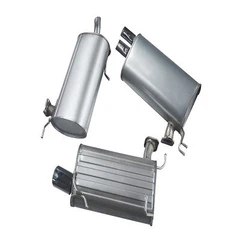
Types Of Mufflers
Aug 09, 2024
Leave a message
Resistive muffler
Different shapes result in different directions of airflow. It is a muffler that is filled with sound-absorbing materials around the pipes through which internal exhaust passes to absorb sound energy and achieve noise reduction. It is rarely used as a car exhaust muffler alone and is usually combined with a resistant muffler. There are porous tubes and sound-absorbing fibers. When the exhaust gas comes into contact with the fibers through the porous tubes, the latter produces vibration and generates heat energy due to friction and viscosity. Noise is converted during this process. Due to its small size, most original car drums prefer to use a drag type. If you want to fully utilize its noise reduction function, the installation position is generally closer to the engine direction. The suppression effect on high-frequency noise in the engine is better than that on low-frequency noise.
Reactive muffler
Internally, various soundproof units such as expansion chambers and resonance chambers are composed of pipes, partitions, and other components, which use the reflection and interference of sound waves to reduce sound energy. It is the type of muffler used in the vast majority of original cars, with good durability and no need to worry about the failure of the sound-absorbing foam. Good noise reduction effect for low and medium frequency bands, poor noise reduction effect for high frequency bands, and resistant mufflers are often used for trucks.
Impedance composite muffler
It has both an expansion chamber and sound-absorbing fibers, combining the characteristics of resistive and resistant mufflers, with a wide range of noise reduction frequencies and good volume flexibility, but the cost is relatively high.
Large hole pressure reducing muffler (search results did not elaborate on its principle, only mentioning this type).
Send Inquiry