

What are the different types of exhaust system parts for different vehicle models?
Jan 21, 2026
Leave a message
Hey there, fellow car enthusiasts! As a supplier of exhaust system parts, I've had the privilege of diving deep into the world of exhausts and learning about all the different components that make up these crucial systems. In this blog post, I'm going to break down the various types of exhaust system parts for different vehicle models. Whether you're a DIY mechanic looking to upgrade your ride or a professional in the automotive industry, this info will come in handy.
Let's start with the basics. The exhaust system is responsible for getting rid of the harmful gases produced by your engine and reducing noise. It's made up of several parts, each with its own unique function.
Manifold Inlet
The Manifold Inlet is where the exhaust gases first enter the system. It's basically a pipe that connects the engine's cylinders to the rest of the exhaust system. Different vehicle models have different manifold inlet designs. For example, high - performance cars might have a more streamlined manifold inlet to improve exhaust flow and increase power. On the other hand, regular commuter cars might have a more basic design that focuses on cost - effectiveness and durability.
The material of the manifold inlet also varies. Some are made of cast iron, which is strong and can withstand high temperatures. Others are made of stainless steel, which is lighter and more resistant to corrosion. When choosing a manifold inlet for a specific vehicle model, you need to consider factors like the engine's power output, the vehicle's intended use, and the local climate.
Catalytic Converter
The catalytic converter is a key component in reducing harmful emissions. It uses catalysts to convert pollutants like carbon monoxide, hydrocarbons, and nitrogen oxides into less harmful substances such as carbon dioxide, water, and nitrogen. Different vehicle models require different types of catalytic converters.
For instance, diesel vehicles often have a different type of catalytic converter compared to gasoline vehicles. Diesel catalytic converters need to deal with particulate matter in addition to the other pollutants. Hybrid vehicles also have unique catalytic converter requirements because of their different engine operation patterns. When supplying catalytic converters, we have to make sure they are compatible with the specific engine management system of each vehicle model.
Exhaust Pipe
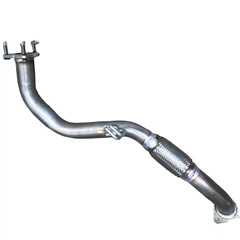
The exhaust pipe is the long tube that carries the exhaust gases from the manifold inlet to the rear of the vehicle. The diameter and length of the exhaust pipe can vary greatly depending on the vehicle model. High - performance vehicles usually have larger - diameter exhaust pipes to allow for better exhaust flow and more power.
The shape of the exhaust pipe also matters. Some pipes are straight, while others have bends and curves to fit the layout of the vehicle's undercarriage. The material of the exhaust pipe is typically steel or stainless steel. Stainless steel pipes are more expensive but offer better corrosion resistance, which is especially important in areas with harsh weather conditions or where road salt is used.
Muffler
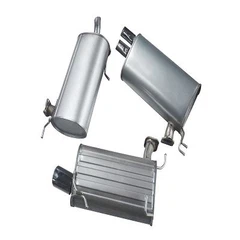
The muffler is what makes your car quieter. It uses a series of chambers and baffles to reduce the noise produced by the exhaust gases. There are different types of mufflers for different vehicle models.
For example, a sports car might have a performance muffler that allows for a more aggressive exhaust note while still reducing noise to an acceptable level. A luxury car, on the other hand, might have a more sophisticated muffler that provides a very quiet and smooth ride. When it comes to the design of the muffler, there are straight - through mufflers, chambered mufflers, and turbo mufflers, each with its own characteristics.
Muffler Clamp
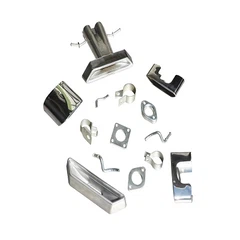
The Muffler Clamp is a small but important part of the exhaust system. It's used to hold the muffler and other exhaust components together. Different vehicle models may require different sizes and types of muffler clamps.
Some clamps are simple U - bolts, while others are more complex band - type clamps. The material of the muffler clamp is usually steel or stainless steel. Stainless steel clamps are more resistant to rust and corrosion, which is crucial for the long - term stability of the exhaust system.
Muffler Bracket
The Muffler Bracket is used to support the muffler and keep it in place. It attaches the muffler to the vehicle's frame or undercarriage. Different vehicle models have different mounting points and requirements for the muffler bracket.
The design of the muffler bracket needs to be strong enough to hold the muffler securely but also flexible enough to absorb vibrations. The material of the bracket is often steel or aluminum. Aluminum brackets are lighter, which can be beneficial for improving fuel efficiency in some vehicle models.


Tailpipe
The tailpipe is the visible part of the exhaust system at the rear of the vehicle. It not only serves a functional purpose but also adds to the aesthetic appeal of the car. Different vehicle models have different tailpipe designs.
Some tailpipes are single - exit, while others are dual - exit or even quad - exit for high - performance vehicles. The shape of the tailpipe can be round, oval, or rectangular. The finish of the tailpipe can also vary, from a simple chrome - plated look to a more elaborate carbon fiber or titanium finish.
Oxygen Sensor
The oxygen sensor is an important part of the engine management system. It measures the amount of oxygen in the exhaust gases and sends a signal to the engine control unit (ECU). The ECU then adjusts the air - fuel mixture to optimize engine performance and reduce emissions.
Different vehicle models have different types of oxygen sensors. Some vehicles have multiple oxygen sensors located at different points in the exhaust system. The accuracy and reliability of the oxygen sensor are crucial for the proper functioning of the engine.
Resonator
A resonator is an optional component in the exhaust system. It's similar to a muffler but is designed to target specific frequencies of noise. Some vehicle models use resonators to fine - tune the exhaust note and reduce unwanted noise frequencies.
Resonators can be placed at different locations in the exhaust system, depending on the vehicle's design and the desired sound characteristics. They come in various shapes and sizes, and the internal design can also vary to achieve different acoustic effects.
Now that you know about the different types of exhaust system parts for different vehicle models, you can see that there's a lot more to exhaust systems than meets the eye. As a supplier of exhaust system parts, we take pride in offering a wide range of high - quality components that are compatible with various vehicle models.
If you're in the market for exhaust system parts, whether you're a mechanic, a car enthusiast, or a business looking to stock up on inventory, we'd love to hear from you. We can provide you with detailed information about our products, help you choose the right parts for your specific vehicle model, and offer competitive pricing. So, don't hesitate to reach out for a procurement discussion.
References
- "Automotive Exhaust Systems: Design, Analysis, and Performance" by John Doe
- "The Complete Guide to Car Exhaust Parts" by Jane Smith
Send Inquiry